Starting May 17th, Brokk Toggerson will have a presentation on the 2021 Perusall Exchange about the use of Perusall in a Graduate Student TA-training & Professional Development Course.
Abstract: Graduate students face several important transitions: becoming a researcher, a teacher, and a colleague. These transitions require specific skills: reading research, giving presentations, and navigating issues of diversity in the workplace. At UMass-Amherst incoming physics Ph.D. students begin developing these skills in a dedicated seminar through the lens of TA training. Students read journal articles about physics education in Perusall: simultaneously honing students’ ability to read research articles and introducing them to teaching best-practices.
Zylich, Brian, Adam Viola, Brokk Toggerson, Lara Al-Hariri, and Andrew Lan. “Exploring Automated Question Answering Methods for Teaching Assistance.” In Artificial Intelligence in Education, edited by Ig Ibert Bittencourt, Mutlu Cukurova, Kasia Muldner, Rose Luckin, and Eva Millán, 610–22. Lecture Notes in Computer Science. Cham: Springer International Publishing, 2020. https://doi.org/10.1007/978-3-030-52237-7_49.
At the end of the Physics 132 course there is a lot of synthesis. The course centers around two fundamental questions: “What is an electron?” and “What is light?” Over the course of the semester, student explore these two ideas from several different directions with the goal of developing a holistic and multifaceted picture by the end of the semester. Along the way, we as a class encounter additional ideas: electric field, electric potential, and magnetic field.
Today, on the last day of class, I typically have students write everything they can think of about these two fundamental questions on small whiteboards and hold them up for me to see. Obviously, under the current circumstances, that is not possible. Enter the word cloud. Obviously, I had seen these all over the web, but I was first exposed to them in a pedagogical context through my TIDE Ambassadorship. In that experience, word clouds were presented as a nice addition to syllabi to make them more inclusive by presenting the objectives of the course in an alternative way. After adding them to my own syllabi, I got to thinking about other ways that these graphics could be used in the classroom.
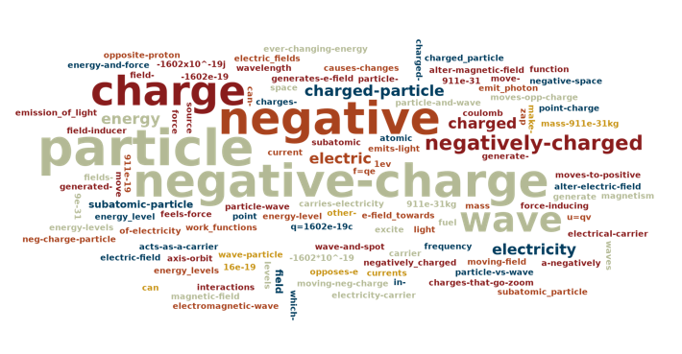
Was there a way to have students construct a word cloud collaboratively that summarized the course? Vevox provides a method. In this free-to-students platform, anyone can create a word-cloud question even with the free account for up to 100 attendees. Due to the pandemic, Vevox is allowing all educators free access to a premium plan that allows up to 1500 attendees (clearly key for me!). Students simply go to http://vevox.app and enter the meeting ID. The polls integrate seamlessly with PowerPoint through a plugin. I then asked students “Define an electron! Anything you can think of is good. Words, equations, you name it. Think across all our units. Remember to use a “-” instead of a space.” The question then opened on their devices and they were given two minutes to write as many things as they could think of. The result was the following word cloud.
The word cloud generated by my students collectively through the vevox platform.
You can see that most of the key components are there and we were able to discuss an lingering misconceptions. The students, in my view, successfully summarized the course – a much more active technique than just me doing it via lecture. This is a cool platform that actually works better for large classes! In a larger class, there is more probability that students will repeatedly say the same, correct, key points. I will almost definitely be using this more in the future.
This semester, I have decided to finally take the plunge for migrating the Physics 132 textbook from the pdf generated by the OpenStaxCNX platform to a much-easier-to-edit format of Pressbooks and simultaneously moving the online preparatory homework from Pearson’s MasteringPhysics (to which I will not link, search for it if you are interested) to Edfinity. This is quite a journey and a lot of work, but I think it will pay off.