Brokk Toggerson has been selected as a UMass ADVANCE Faculty Fellow for the 2020-2021 Academic Year. ADVANCE Faculty Fellows partner with the ADVANCE-IT Team, providing recommendations and feedback about ADVANCE programming and resources, and promoting ADVANCE program efforts in their departments. There is one faculty member from each department for a twelve-month term.
Through the power of collaboration, UMass ADVANCE transforms the campus by cultivating faculty equity, inclusion and success. ADVANCE provides the resources, recognition and relationship building that are critical to equitable and successful collaboration in the 21st century academy.
UMass ADVANCE is funded by the National Science Foundation (NSF), which is advancing women faculty, including women faculty of color, in science and engineering.
For 2020-21, ADVANCE’s focus will be on inclusion, particularly with an emphasis on “Inclusion and Covid-19,” since the pandemic has had a differential effect on faculty members. Brokk will be invited to take part in meetings for ADVANCE Faculty Fellows in Fall 2020 and Spring 2021, and will also be a link in desseminating information to the physics department.
Assume that your students are going to have a lot going on, that some of it will be unpredictable, and that none of it is your business to know–and yet you must design a remote course around it.
Rebecca Barrett-Fox
I stumbled on these during the semester and building my remote course. However, I did not have time at that moment to reflect on it here.
This is a really important article, I think. Particularly for those of us who teach large courses: the larger the course, the higher the larger variety of difficult situations your students are facing, and the harder it is to deal with them one-at-a-time. Thus, while such thinking should be standard practice, for large courses, the instructor MUST design in such a way to make the course as equitable as possible. In the remote-teaching world equity includes thinking about the home lives of yourself and your students and how those environments impact teaching and learning. Thinking about digital privacy is another factor that must be considered.
Trying to design a course around challenges that you don’t, and shouldn’t, know exist as well as around difficulties your students don’t know they have is tough, but something important to keep in mind as we plan for the possibility of remote in the fall.
At the end of the Physics 132 course there is a lot of synthesis. The course centers around two fundamental questions: “What is an electron?” and “What is light?” Over the course of the semester, student explore these two ideas from several different directions with the goal of developing a holistic and multifaceted picture by the end of the semester. Along the way, we as a class encounter additional ideas: electric field, electric potential, and magnetic field.
Today, on the last day of class, I typically have students write everything they can think of about these two fundamental questions on small whiteboards and hold them up for me to see. Obviously, under the current circumstances, that is not possible. Enter the word cloud. Obviously, I had seen these all over the web, but I was first exposed to them in a pedagogical context through my TIDE Ambassadorship. In that experience, word clouds were presented as a nice addition to syllabi to make them more inclusive by presenting the objectives of the course in an alternative way. After adding them to my own syllabi, I got to thinking about other ways that these graphics could be used in the classroom.
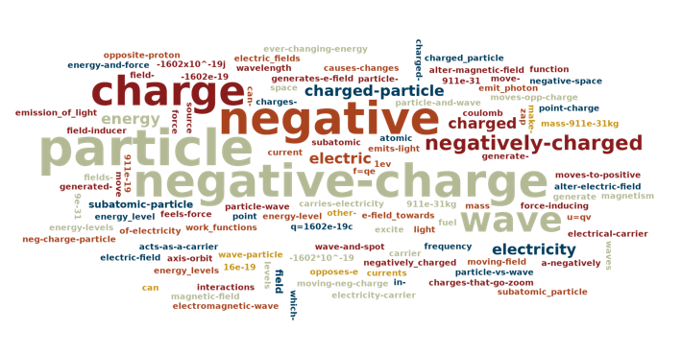
Was there a way to have students construct a word cloud collaboratively that summarized the course? Vevox provides a method. In this free-to-students platform, anyone can create a word-cloud question even with the free account for up to 100 attendees. Due to the pandemic, Vevox is allowing all educators free access to a premium plan that allows up to 1500 attendees (clearly key for me!). Students simply go to http://vevox.app and enter the meeting ID. The polls integrate seamlessly with PowerPoint through a plugin. I then asked students “Define an electron! Anything you can think of is good. Words, equations, you name it. Think across all our units. Remember to use a “-” instead of a space.” The question then opened on their devices and they were given two minutes to write as many things as they could think of. The result was the following word cloud.
The word cloud generated by my students collectively through the vevox platform.
You can see that most of the key components are there and we were able to discuss an lingering misconceptions. The students, in my view, successfully summarized the course – a much more active technique than just me doing it via lecture. This is a cool platform that actually works better for large classes! In a larger class, there is more probability that students will repeatedly say the same, correct, key points. I will almost definitely be using this more in the future.
When UMass-Amherst decided to go to remote learning after spring break, I needed one more lab for my Physics 132 – IPLS II course. This course has a traditional setup where the lab is run semi-autonomously from the “lecture” portion of the course. For the last two iterations, however, the lab has been run with a different focus based on data analysis. Thus, a lab focused on understanding the exponential growth patterns and fitting the parameters fit well with our education objectives and could be done with publicly available data.
While this may not be “physics” per se, I think that such a lab makes sense:
It uses all of the skills our students have been developing over the course of the semester.
It is topical.
It is probably of interest to the predominately life-science students who comprise the student population of 132.
It will hopefully help students see that the skills they learned in physics lab are not unique to physics, but instead valuable to all of science.