This past semester, I moved my Physics 564: Quantum Mechanics II course to an alternative grading scheme, representing my first real attempt at such a structure. This post is both a summary of my experiences and a reflection. A copy of the syllabus, with mid-semester modifications indicated, and a sample quiz are also available.
Acknowledgements


This effort would not have been possible without two colleagues: Dr. Sara Cavallo from the UMass Amherst Center for Teaching and Learning, and my graduate TA, Ms. Alexandria Nolan. Dr. Cavallo’s expertise on alternative grading was invaluable both as I was initially planning my new course structure and during a mid-semester check-in and adjustment session. In addition to her critical role in facilitating the implementation of the innovative pedagogy, Ms. Nolan was a critical source for on-the-ground perspective and feedback regarding logistics, TA workload, and the student experience were invaluable.
Structure Prior to Spring 2026
Who
- ~ 10-20 students.
- Mostly 3rd years.
- Some 4th and MS students.
- About 10% from engineering!
What
- Group Theory
- Fundamentals.
- Lie Groups.
- Griffiths Ch 5:
- Multiple Particle Systems.
- Free Electron Gas.
- Dirac Comb.
- Atoms
- Griffiths Ch 6:
- Parity and Translation.
- Rotations.
- Symmetries.
- Griffiths Ch 7:
- Time Independent Perturbation Theory
- Corrections to Hydrogen Atom.
As it is relevant to my transition to an alternative grading scheme, I would like to draw particular attention to my selection of topics in prior iterations of the course; in the past, I spent 3 weeks of a 13-week semester on the fundamentals of group theory. I would then use this group theory knowledge as a thread through the rest of the course: parity as an application of discrete groups, crystals as an application of the translation group, and a deeper dive into a group-theory-based theory of rotations. As these topics are beyond the scope of Griffiths & Schroeter’s Quantum Mechanics, 3rd Ed., I had to rely on my own notes compiled from other sources.
Motivations for Change
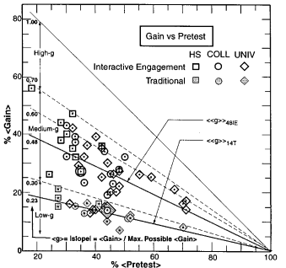
Active Learning is More Effective
•R. R. Hake, AJP 66, 64 (1998).
Grade/Performance Mismatch
- Some students earned A’s even with only getting a few exam problems completely correct.
- Grade stitched together from consistent partial credit.
- I want better grade/performance correspondence.

AI
- Homework was 20% of grade in prior implementation.
- Started receiving AI generated homework solutions in Spring 2025.
- I have zero interest in grading AI generated solutions.
Culture Dependence
- The level of engagement was heavily dependent on the specific culture of a specific group of students.
- This is not the case with 132 (~300/section) where the law of averages takes over.
- I would like my class’s success to be more independent of classroom composition.
While the literature is clear that, even for upper-division physics courses, active learning pedagogies are more effective than straight lecture[1], my prior efforts to incorporate any level of activity generally had limited success. My choice to build my own narrative independent of a standard text effectively precluded a consistent application of the flipped pedagogies on which I generally rely to make time for the, necessarily more time-intensive, activities. Without consistent preparation, class sessions necessarily oscillated between meetings with lots of active learning and traditional lecture-focused ones. Consequently, students never developed the consistent habits of scholarship needed for an active learning classroom: consistent attendance and engagement. In retrospect, I should have expected this result; when teaching Intro Physics for Life Sciences I, I spend a significant amount of class time establishing, and reinforcing, a classroom culture of expecting participation. Moreover, experience has taught me that this acculturation work cannot come only at the start of the semester. If a culture of participation is not consistently expected, students will quickly lose the habit as their prior experience has been so overwhelmingly lecture-dominated.
Grading for Growth[2] and Standards-Based Grading
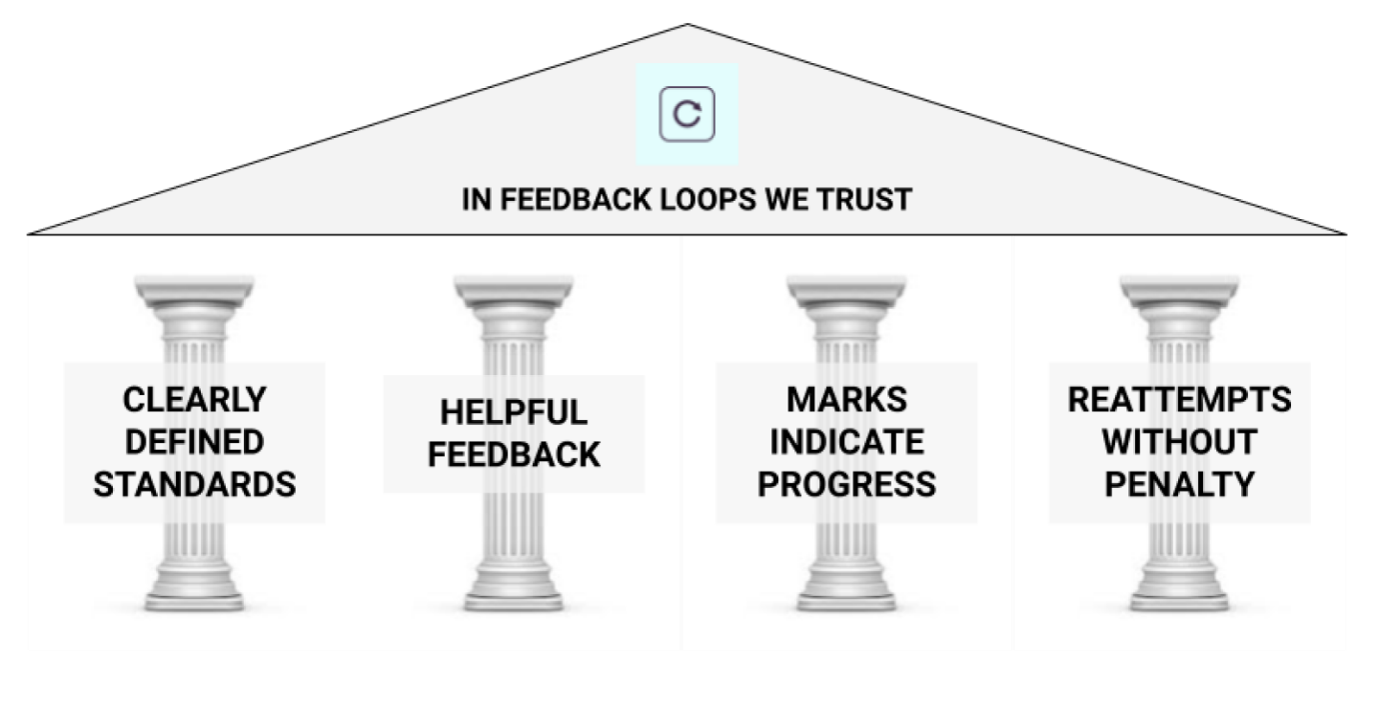
I highly recommend this book to anyone considering alternative grading schemes, particularly to faculty teaching STEM disciplines. The authors’ background teaching introductory calculus makes their experience easily transferable to subjects like physics, though I fully expect faculty in other fields would find it useful as well. The book discusses several different alternative grading schemes. I ultimately settled on a standards-based system. This system is predicated on backward design: the course is divided into different objectives. Students are then given multiple attempts to pass each objective via a series of quizzes which are graded with essentially no possibility for partial credit. If students do not pass the assessment, they get feedback before their next try.
How I Implemented Standards-Based Grading in Physics 564
Objectives
In Physics 564, I divided my list of 10 objectives, listed in above, into two categories: core and auxiliary (indicated with italics). Core objectives are those topics which I feel are essential if one is to say one has mastered QMII, such as time-independent perturbation theory (TIPT). Auxiliary objectives, by contrast, are generally applications of core objectives: for example, fine structure as an application of TIPT. In order to pass a core objective, students had five attempts to get two quizzes correct. For auxiliary objectives, students only needed to pass one quiz of the five available. In all cases, there was no time limit by which students must complete their quizzes, allowing them to take their time preparing and only take the quizzes when they are ready.
You can also see in the list a “Module Zero” with a single objective: Addition of Angular Momentum. I did not spend class time on this topic, as it is review from QMI. However, as it is so fundamental for so many of the other objectives, I wanted to ensure everyone had sufficiently mastered the topic.
- Module 0
- From QM I, you should be able to add quantum angular momenta quickly and correctly as this will be a key skill in the rest of this course.
- Module 1: Symmetries, Conservation Laws, and their Application to Solids
- You should be able to apply the parity and translation operators to different wavefunctions to derive characteristics of the system.
- You should be able to rotate quantum states and operators and draw conclusions about their behavior.
- You should be able to interpret the fundamental relationship describing the En for a solid in the Dirac-comb model both analytically and graphically.
- Module 2: Multiple Particle Systems, Atoms, and the Free Electron Gas.
- You should be able to construct a wave function for multiple particles with the correct (anti-)symmetrization.
- You should be able to write the electron configuration for any atom on the periodic table.
- You should be able to derive and interpret the properties of free electron gases in any number of dimensions.
- Module 3: Time-Independent Perturbation Theory
- You should be able to solve non-degenerate problems using time independent perturbation theory to second order.
- You should be able to find “good states” for the application of time-independent perturbation theory to first order in the situation of degenerate states.
- You should be able to Describe the origins of fine structure and hyperfine structure (i.e. order 𝛼2 and 𝛼4 corrections to the hydrogen atom) and derive/interpret their effects.
- Module 4: Time Dependent Perturbation Theory
- You should be able to apply time-dependent perturbation theory to two-level systems in the case of delta-function and sinusoidal perturbations.
How I Organized Class
- Preparation
- In Perusall.
- Growth-based grading of comments: the first assignment was graded on good-faith. Future assignments graded on if students improved.
- Due dates set the “on schedule” for the course.
- Class Time
- Topic begins with ~45min discussion addressing the biggest questions in the reading.
- The rest of class time is spent working homework problems.
- Homework
- Not collected.
- Solutions posted on posted dates to maintain schedule.
- Assessment
- 5 Quizzes available on each topic.
- Quizzes available during 2 3hr sessions run by Alexandria and graded in the moment.
- Need to pass
- 2 for core objectives
- 1 for auxiliary objectives
- Pass Correct (no partial credit!)
Grading Scale
The grading scale for my quizzes had four levels:
(S) Satisfactory
This is the only passing grade. In order to earn this mark, students must get the problem completely correct.
(MR) Minor Revisions Needed
This grade was to make allowances for the silly/minor arithmetic/algebraic errors that everyone makes when doing math under pressure. Students who earned this grade were invited to review the solutions and identify their error. Once found and explained, MRN grades would be upgraded to Pass. This was the only possibility for partial credit.
(AAR) Another Attempt Required
This is for any submission which had anything beyond silly/minor arithmetic/algebraic errors. Specifically, any solution with a conceptual error earned this mark.
(I) Incomplete/Illegible
For solutions which are incomplete or illegible.
“Quality of Solutions” Objective
In addition to the physics objectives listed, I also added one focused on the “Quality of Solutions.” This objective was added in response to seeing past student solutions which I felt were lacking in formality. I want students’ solutions to not only be neat, but also to go beyond a list of equations and contain word-based explanations of what is going on physically. This objective was graded using the scale below.
Excellent
An instructor-level solution which could be used as a published solution in the future.
Satisfactory
A good student-level solution which covers the characteristics of a quality solution listed above.
Progressing
Meets some of the specifications. Again, our TA will provide feedback here.
Insufficient
There is not enough information in the solution to be able to assess the work. The work may be incomplete or too illegible to read.
The goal was for students to develop a habit of quality solutions meaning that there were three in a row that are Satisfactory or Excellent.
How I Converted to Final Letter Grades
- A grade of ‘A’ requires students to…
- Pass Module-0 with two successful attempts.
- Pass all 6 core objectives with two successful attempts.
- Pass 3 out of 4 auxiliary objectives with one successful attempt.
- Earn at least 3 sequential ‘Satisfactory’ or ‘Exemplary’ marks for the Quality Solutions objective, with at least one being ‘Exemplary.’
- Successfully complete 75% of the prep assignments.
- A grade of ‘B’ requires students to…
- Pass Module-0 with two successful attempts.
- Pass 4 out of 6 core objectives with two successful attempts.
- Pass 2 out of 4 auxiliary objectives with one successful attempt.
- Earn at least 3 sequential ‘Satisfactory’ or ‘Exemplary’ marks for the Quality Solutions objective.
- Successfully complete 50% of the prep assignments.
- A grade of ‘C’ requires students to…
- Pass 2 out of 6 core objectives with two successful attempts.
- Pass 1 out of 4 auxiliary objectives with one successful attempt. Earn at least 2 sequential ‘Satisfactory’ or ‘Exemplary’ marks for the Quality Solutions objective.
- Successfully complete 25% of the prep assignments.
- A grade of ‘D’ requires students to…
- Pass 2 core objectives with two successful attempts.
- Earn at least one ‘Satisfactory’ or ‘Exemplary’ marks for the Quality Solutions objective.
- +/-‘s
- These are for earning parts, but not all, of the next threshold. For example, if you meet the criteria for a ‘C,’ but have also
- Passed Module 0, you will earn a C+
- Passed Module 0 and a second auxiliary objective, you will earn a B-
- These are for earning parts, but not all, of the next threshold. For example, if you meet the criteria for a ‘C,’ but have also
Review and What I Will Do Differently Next Time
In general, I would consider this past semester to be rather successful for a first attempt. There are, of course, also a few aspects of the course I would like to improve in future implementations of this structure.
Perusall
In particular, I am impressed with how proficient students became in reading the textbook. By semester’s end, all students were engaging deeply with the textbook: filling in the omitted steps of derivations and uploading their solutions to various textbook problems to Perusall. I also noticed increased student-to-student engagement in Perusall as the semester progressed; students were really using comment threads to facilitate each other’s understanding. In fact, several students mentioned developing their physics reading skills as one of the most useful things they learned in Physics 564. I think frequent and rapid replies on Perusall were key to this success.
Changes in Class-Time Usage and Group Construction
Going into the semester, I planned on using class time in a very student-led manner. I planned on spending a few minutes each week addressing and discussing those parts of the reading on which there seemed to be the most questions. The remainder of class would then be a “study hall” model wherein students could ask individual questions of me, or work on problems from the suggested-problems homework, ideally collaboratively.
Such an open-ended structure was clearly inappropriate. While classroom attendance started off well, it fell significantly as the semester progressed: a feature I interpret economically. Students simply did not find class time to be of sufficient value to attend an 8:30–9:45 am class on Tuesday and Thursday mornings. Consequently, in the future, I would like to add more structure along the lines of my 131 TBL activities: choosing specific problems that I think are particularly relevant, and dividing the class into groups to work on them at the boards. In fact, one student suggested such a strategy, with instructor-formed groups. I had not formed groups because I felt that the existing cohort cohesion among such a group of 3rd- and 4th-year physics majors would override the need for instructor-formed groups.
These observations reinforce a belief that the principles of good classroom group construction are, of course, quite universal. Next time, I will survey the students for their attendance plans as asll as their experience in Quantum I. I will then use these data to build groups of about 4. As for changing the groups, the literature suggests keeping them together for the semester. However, the TBL literature also suggests making students’ grades partially dependent on group performance which I feel is inappropriate for a 500-level class. If a student is capable of doing well on-their-own, then I want them to be able to do so. Thus, next time I will offer the students the option of mixing up the groups every few modules.
Changes in Quiz Administration and Feedback
The quiz administration system also requires adjustment. Ms. Nolan, on whom I relied to administer the quizzes last spring provides an excellent basis on which to plan future iterations: she is always deeply committed to student success, flexible with their schedules (up to a point of course), and, as mentioned previously, provided excellent pedagogical insights on how to improve the course as we proceeded throughout the semester. However, she did struggle with paper management and feedback.
Paper management is important as all quizzes were administered this way. Fortunately, it is also an easy problem to solve now that most all of the quizzes are written. Next time, I will work with my TA at the start of the semester to find a system that works for them. For example, one possible solution could simply be to make a large binder with sufficient copies of all the quizzes as well as a copy of the relevant solution thereby eliminating the need for the TA to navigate my personal file structure or access a printer.
The issue of feedback is both more important and more challenging to solve. This past semester, my TA followed the traditional custom of taking the quizzes home to grade later. In contrast, when I held quizzing sessions during the finals period, I graded quizzes immediately as students turned them in. Such immediate grading provided an opportunity to give immediate feedback and sometimes even having a subsequent discussion in the moment of their specific misconceptions or mathematical errors. According to Grading for Growth, as well as other education literature such as Make it Stick[3], such immediate feedback is the most effective and would greatly enhance the effectiveness of the standards-based grading scheme.
Supporting Future TAs
How can I support future TAs in successfully implementing such a strategy? The first step, I think, is to attend and jointly run the first few sessions. While my TA last spring and I had a start-of-semester discussion on the patter, I think its unfamiliarity to both of us means that joint-run sessions would improve clarity for all: not only my expectations of the TA’s behavior, but also my understanding of the on-the-ground challenges. Additionally, having a short session each week with just the TA and myself to review the newly-added quizzes would provide an important opportunity to review the quiz solutions and anticipate together likely student mistakes. Such meetings would also provide an opportunity to discus the most effective feedback in each case.
Encouraging Students to Keep Up
The last challenge I need to address regards ensuring students stay on top of the their quizzes. A high-enough number of students consistently delated taking quizzes and then tried to pass several objectives in a short period towards the end of the semester including the finals period. Such a strategy seems to circumvent the entire purpose of the standards-based pedagogy by precluding an opportunity to receive feedback, go home and study some more, and return with an improved chance of passing the next quiz.
Initially, I tried to address this propensity to procrastinate on the part of some students by offering the five quizzes only over five quiz sessions, approximately 2.5 weeks. However, Ms. Nolan pointed out that such a restriction disadvantaged students who could not attend one of the weekly quiz sessions due to external obligations as they would not have access to the full five attempts at the objective. Consequently, I removed that restriction as shown in the syllabus. This change, however, enabled the procrastination. On this point, I still need to do some thinking.
Moving Forward
As stated previously, I think the Spring 2026 semester was a rather successful first attempt in implementing standards-based grading. With the changes outlined above, I also think that this structure is well suited to a variety of different courses throughout the physics curriculum: from first semester courses where it would ensure mastery of fundamentals through the 500-level courses presented here.
In more introductory courses, a different homework policy would need to be developed. By the 500-level class, students are already fully aware of the importance of doing the homework in order to learn the material. However, I am not so sure that a first-semester-student would have the requisite academic maturity. Perhaps a homework correction system such as that presented in Griston and Wilcox[4] which my colleague Verena Martinez Outschoorn has already explored in her Mathematical Methods II course would work.
However, this challenge, and the others mentioned above are, in my opinion, well worth figuring out. Not only does this pedagogy ensure mastery, but it is also promotes equity as the multiple attempts allow students with different levels of preparation to take the time they need to get to where they need to be. In addition, the low importance of homework makes the course resilient to AI. I look forward to continuing to explore this pedagogy in different contexts.
[1] Stephanie V. Chasteen, Bethany Wilcox, Marcos D. Caballero, Katherine K. Perkins, Steven J. Pollock, and Carl E. Wieman, Educational transformation in upper-division physics: The Science Education Initiative model, outcomes, and lessons learned, Phys. Rev. ST Phys. Educ. Res. 11, 020110 (2015).
[2] D. Clark, R. Talbert, and L. B. Nilson, Grading for Growth (Routledge, New York London, 2023).
[3] Peter C. Brown, Henry L. Roediger III, and Mark A. McDaniel, Make It Stick: The Science of Successful Learning (Bleknap Press, Cambridge, MA, 2014).
[4] M. Griston and B. R. Wilcox, Motivating reflection in problem solving: Homework corrections in upper-division physics courses, Phys. Rev. Phys. Educ. Res. 21, 020113 (2025).